Menampilkan postingan yang diurutkan menurut relevansi untuk kueri runaway-story-or-meltdown-in-motion. Urutkan menurut tanggal Tampilkan semua postingan

Sabtu, 31 Desember 2005

Runaway Flush Or Meltdown Inwards Motion? The Unraveling Of The Wework Ipo

In a yr total of high-profile IPOs, WeWork takes middle phase every bit it moves towards its offering date, offering a fascinating insight into corporate narratives, how as well as why they acquire credibility (and value) as well as how rapidly they tin lose them, if markets lose faith. When the WeWork IPO was start rumored, at that spot was beak of the companionship existence priced at $60 billion or more, but the longer investors remove hold had a adventure to aspect at the prospectus, the less enthusiastic they seem to remove hold travel almost the company, amongst a news story today reporting that the companionship was looking at a drastically discounted value of $20 billion, which would create Softbank, the biggest (and most recent) VC investor inwards WeWork, a large loser on the IPO. Before I laid my thoughts downward on WeWork, I volition confess that I remove hold never liked the company, partly because I don't trust CEOs who seem to a greater extent than intent on delivering life lessons for the remainder of us, than on talking almost the businesses they run, as well as partly because of the trail it has left of obfuscation as well as opaqueness. That said, I don't believe inwards writing hitting pieces on companies as well as I volition curvature over backwards to give WeWork the do goodness of the doubt, every bit I wrestle non only amongst its basic occupation organization model but too amongst converting that model into a story as well as numbers.

The WeWork Business Model: Influenza A virus subtype H5N1 Leveraged Bet on Flexibility
The WeWork occupation organization model is neither new, nor peculiarly unique inwards its basic form, though access to uppercase as well as scaling ambitions remove hold pose that model on steroids. That said, most traditional existent estate companies that remove hold tried the WeWork occupation organization model historically remove hold abandoned it, for micro as well as macro reasons, as well as the exam of the WeWork model is whether the advantages it brings to the table, as well as it does convey some, tin assist it succeed, where others remove hold not.

The Business Model
Most businesses demand constituent infinite as well as the means inwards which that constituent infinite is created as well as provided has followed a criterion script for decades. The possessor of an constituent building, who has by as well as large acquired the edifice amongst pregnant debt, rents the edifice to businesses that demand constituent space, as well as uses the rent payments received to comprehend involvement expenses on the debt, every bit good every bit the expenses of operating the building. As economies weaken, the demand for constituent infinite contracts, as well as the resulting driblet inwards occupancy rates inwards constituent buildings exposes the possessor to risk. Prudent existent estate operators travail to purchase buildings when existent estate prices are low, as well as sign upwardly credit worthy tenants amongst long term leases when rental rates are high, thus edifice a profitability buffer to protect themselves against downturns, when they do come. Even amongst added prudence, commercial existent estate has ever been a smash as well as bust occupation organization as well as fifty-fifty the most successful existent estate developers remove hold been both billionaires as well as bankrupt (at to the lowest degree on paper), at dissimilar points of their lives.

The WeWork occupation organization model puts a twist on traditional existent estate. Like the conventional model, it starts past times identifying an attractive constituent property, commonly inwards a metropolis where constituent infinite is tight as well as immature businesses are plentiful. Rather than buying the building, WeWork leases the edifice amongst a long term lease, as well as having leased it, it spends pregnant amounts upgrading the edifice to create it a desirable constituent infinite for the Gen-X as well as Gen-Y workers, brought upwardly to believe inwards the tech companionship paradigm of a cool constituent space. Having renovated the building, WeWork as well as then offers constituent infinite inwards little units (you tin rent only ane desk or a few) as well as on brusque term contracts (as brusque every bit a month). For a given property, if things travel according to plan, every bit the edifice gets occupied, the excess of rental income (over the lease payment) is used to comprehend the renovation costs, as well as in ane lawsuit those costs acquire covered, the economies of scale boot in, generating profits for the company. The steps inwards the WeWork occupation organization model are captured inwards the pic below:
If y'all purchase into the company’s spin, every bit presented inwards its prospectus, the strengths it brings to each phase inwards the procedure are what sets it apart, allowing it to win, where others remove hold failed before. In fact, the companionship is explicitly laying the foundations for this declaration amongst ii graphs inwards its prospectus, ane of which maps out its fourth dimension frame from signing to filling a location as well as the other which presents a picture, albeit a petty skewed, of the profitability of each location, in ane lawsuit stable.
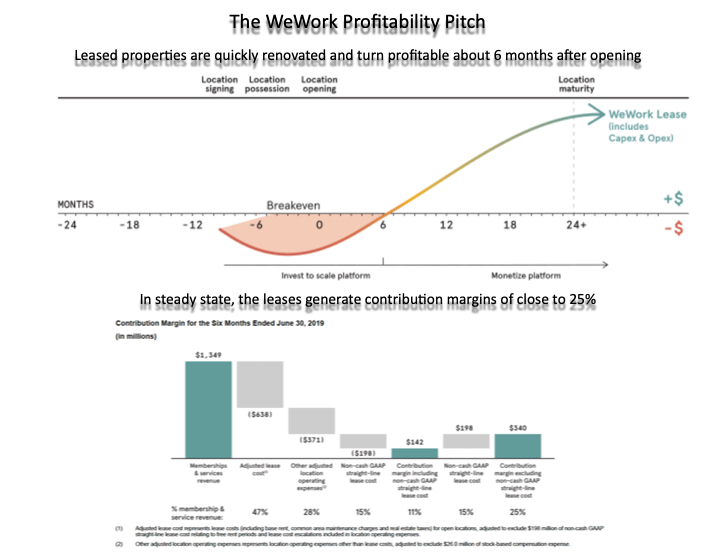
Prospectus: Pages 
Note that all nosotros remove hold is the company's discussion on the timing as well as its Definition of contribution margin plays fast as well as loose amongst operating expenses. To illustrate how the WeWorks model works, consider 600 B Street inwards San Diego, which is an constituent edifice that WeWork acquired, renovated as well as opened inwards 2017:


In 2019, WeWork claimed that the edifice was mostly occupied, which should hateful that the renovation costs are existence recouped, but since the companionship does non reveal per-building numbers, it is impossible to tell what the company's financials are only on this building. 

The Model Trade off
The model's allure is built on 3 factors. The start is the WeWork look, amongst opened upwardly operate spaces, cool lighting as well as lots of extras, that the companionship has worked on edifice over its lifetime as well as presumably is able to duplicate inwards a novel building, amongst cost savings as well as quickly. The 2d is the WeWork community, where the companionship supplements its cosmetic features amongst add-on services that arrive at from occupation organization networking to consulting services as well as seminars. The 3rd is its offering of flexibility to businesses, especially valuable at immature companies that human face uncertain futures but increasing becoming so fifty-fifty at established companies that are experimenting amongst alternate operate structures. Presumably, these businesses volition live willing to pay extra for the flexibility as well as WeWork tin capture the surplus. The model's weakness lies inwards a mismatch that is at the pump of the occupation organization model, where WeWork has locked itself into making the renovation costs upwardly front end as well as the lease payments for many years into the future, but its rental revenues volition ebb as well as flow, depending upon the the world of the economy. In fact, the numbers inwards WeWork’s ain prospectus give away the extent of this mismatch, amongst lease commitments showing an average duration inwards excess of 10 years, whereas its renters are locked into contracts that average almost a yr inwards duration, which I obtained past times dividing the revenue backlog past times the revenue run rate. This mismatch is non unique to WeWork. You tin struggle that hotels remove hold ever faced this problem, every bit do the owners of floor buildings, but WeWork is peculiarly exposed for iv reasons:
  1. Own versus lease: There is an declaration to live made that owning a belongings as well as leasing it is less risky than leasing the belongings as well as and then sub-leasing it, as well as it is non because buying a belongings does non give ascent to fixed costs. It does, inwards the shape of the debt that y'all accept on, when y'all purchase the property, but borrowing & buying comes amongst ii advantages over leasing. First, when buying a property, y'all tin create upwardly one's hear the proportion of value that comes from equity, allowing y'all to trim down your fiscal leverage, if y'all experience over exposed. Second, if the belongings value of a edifice rises after y'all remove hold bought it, the equity element of value builds upwardly implicitly, reducing effective leverage, though if belongings values drop, the opposite volition occur.
  2. Explosive growth: As nosotros volition reckon inwards the side past times side section, WeWork does non only remove hold a mismatched model, it is ane that has scaled upwardly at a charge per unit of measurement that has never been seen inwards the existent estate business, going from ane belongings inwards 2010 to to a greater extent than than 500 locations inwards 2019, adding to a greater extent than than 100,000 foursquare feet of constituent infinite each month. This global growth has given ascent to gigantic lease commitments, which combined amongst its operating losses inwards 2018, create it peculiarly exposed.
  3. Tenant Self-selection: By specifically targeting immature companies as well as businesses that value flexibility, the companionship has created a selection bias, where its customers are the ones most likely to line dorsum on their constituent rentals, if at that spot is a downturn.
  4. Lack of cost discipline: Companies that remove hold historically been exposed to the mismatch occupation remove hold learned that, to survive, they demand to remove hold cost discipline, keeping fixed cost commitments depression as well as adjusting rapidly to changes inwards the environment. While it is possible that WeWork is secretly next these practices, their prospectus seems to propose that they are oblivious to their peril exposure.
It is worth noting that the WeWork occupation organization model has been tried inwards existent estate before, amongst calamitous results. As Sam Zell, a billionaire amongst deep roots inwards existent estate, noted on CNBC, on September 4, 2019, non only did he lose money investing inwards a occupation organization model similar this ane inwards 1956, but every companionship inwards the constituent infinite subletting infinite that existed as well as then went out of business.

The Back Story
To sympathize where WeWork stands today, I started amongst the prospectus that the companionship filed on August 14. While this filing may live updated, it provides a footing for whatever story telling or valuation of the company.

1. Operations
The financials reported inwards a companionship clearly pigment a pic of growth inwards the company, every bit tin live seen on almost every operating dimension (cities, locations, tenants, revenues).

While the growth represents the proficient tidings constituent of the story, at that spot is bad news. Accompanying the growth inwards locations as well as revenues are losses that remove hold grown to staggeringly large amounts past times 2018.
EBITR= EBIT + Lease Expense, EBITR&PO = EBITR + Non-lease pre-opening expenses
One declaration that the companionship may create for its losses is that they are after operating lease expenses (which are fiscal expenses, i.e., debt) as well as pre-opening location expenses (which are uppercase expenses). Adjusting for these expenses create the losses smaller, but they notwithstanding remain daunting.

2. Leverage: The Leasing Machine
The WeWork occupation organization model is built on leasing properties, frequently for large amounts, amongst a long-period commitment, as well as non surprisingly, the results are manifested inwards lease commitments that stand upwardly for a mount of claims that the companionship has to comprehend earlier it tin generate income for equity investors. The graph below captures the lease commitments that WeWork has contractually committed itself to for futurity years, as well as how much these commitments stand upwardly for inwards equivalent debt:
Prospectus
Brought downward to basics, WeWork is a companionship that had $2.6 billion inwards revenues inwards the twelve months ending inwards June 2019, amongst an operating loss of to a greater extent than than $2 billion during the period, as well as debt outstanding, if y'all include the conventional debt, of unopen to $24 billion. Note that this leverage is built into the occupation organization model as well as volition only grow, every bit the companionship grows. The promise is that every bit the companionship matures, as well as its leaseholds age, they volition plow profitable, but this is a model built on a knife’s border that, past times design, volition live sensitive to the smallest economical perturbations.

3. Issuance Details
To value an initial populace offering, y'all demand 3 additional details as well as at the moment, information on at to the lowest degree ii of the 3 details is non fully disclosed, though it volition live made populace earlier the offering.
  • Magnitude of Proceeds: While the companionship has non been explicit almost how much cash it plans to enhance inwards the IPO, rumors every bit of late every bit final calendar week suggested that it was planning to enhance almost $3.5 billion from the offering. Of course, that was premised on a belief that the marketplace would toll their equity at almost $45-$50 billion as well as that may change, at nowadays that at that spot are indications that it may remove hold to settle for a lower pricing.
  • Use of Proceeds: In the prospectus (page 56), the companionship says that it intends to usage the cyberspace proceeds for full general corporate purposes, including working uppercase as well as uppercase expenditures. In effect, at that spot seem to live no plans, at to the lowest degree currently, for whatever of the existing equity owners of the occupation solid to cash out of the firm, using the proceeds. 
  • Dilution: There volition live additional shares issued to enhance the planned proceeds, as well as the offering toll volition determine the part count. There volition live circularity involved, because the proceeds, since they volition remain inwards the firm, volition increase the value of the occupation solid (and equity) past times roughly the amount raised, as well as thus the value per share, but the value per part itself volition determine how many additional shares volition live issued as well as thus the part count.
I volition do my initial valuation amongst the rumored $3.5 billion proceeds amount as well as usage the estimated value per part to adjust part count, but these numbers volition demand to live revisited, in ane lawsuit at that spot is to a greater extent than concrete information.

4. Corporate Governance: Founder Worship as well as Complexity
In keeping amongst what has travel almost criterion do for companies going populace inwards the final decade, WeWork has muddy the corporate governance waters past times creating both a complex holding construction as well as part classes amongst dissimilar voting rights. Let's start amongst the holding construction for the company:
Prospectus: Page
In particular, annotation the carve out of a split companionship (ARK) which volition presumably purchase existent estate as well as lease it dorsum to We as well as the region-specific articulation ventures, where the companionship collects management fees. I am non quite certainly what to create of the partnership triangle at the center, where it looks similar the companionship volition live partnering amongst it's ain managers (with the founder/CEO presumably leading the way) to run WeWork Company. I remove hold to compliment the company's owners as well as bankers, as well as it is a back-handed compliment, for managing to create to a greater extent than complexity inwards a distich of years than most companies tin create inwards decades. Some of this complexity is in all probability due to revenue enhancement reasons, inwards which illustration the companionship is behaving similar other existent estate ventures inwards putting revenue enhancement considerations high upwardly on its listing of decision-drivers. Some of the complexity is to protect itself from the downside of its ain lease-fueled growth, where the companionship tin maintain the declaration that since its leases are at the property-level, as well as the properties are structured every bit nominally stand-alone subsidiaries, it is less exposed to distress. That is fiction because a global economical showdown volition atomic number 82 to failures on dozens, mayhap hundreds, of lease commitments at the same time, as well as at that spot is no protective cloak for the companionship against that contingency. Influenza A virus subtype H5N1 cracking bargain of the complexity, though, has to do amongst the founder(s) wishing for command as well as potential conflicts of interests, as well as investors volition remove hold to accept that into occupation organization human relationship when valuing/pricing the company.

On the governance front, the company’s voting construction continues the lamentable do of entrenching founders, past times creating 3 classes of shares, amongst the shape Influenza A virus subtype H5N1 shares that volition live offering inwards the IPO having ane twentieth the voting rights of the shape B as well as shape C shares, leaving command of the companionship inwards the hands of Adam Neumann. In fact, the prospectus is brutally direct on this front, stating that “Adam’s voting command volition bound the might of other stockholders to influence corporate activities and, every bit a result, nosotros may accept actions that stockholders other than Adam do non view every bit beneficial” as well as that his ownership stake volition resultant inwards WeWork existence categorized every bit a controlled company, relieving it of the requirement to remove hold independent directors on its compensation as well as nominating committees.

Valuing WeWork
As I mentioned at the top of this post, I fundamentally mistrust the company, but I am non willing to dismiss its potential, without giving it a shot at delivering. In creating this narrative, I am buying into parts of the company’s ain narrative as well as hither are the components of my story:
  • WeWork meets an unmet as well as large demand for flexible constituent space: The demand comes both younger, smaller companies, notwithstanding unsure almost their futurity needs, as well as established companies, experimenting amongst novel operate arrangements. There is a large market, potentially unopen to the $900 billion that the companionship estimates.
  • With a branded production & economies of scale: The WeWork Office is differentiated plenty to allow them to remove hold pricing power, as well as higher margins.
  • And continued access to capital, allowing the companionship to both fund growth as well as potentially alive through mild economical shocks. That access, though, volition live insufficient to tide them through deeper recessions, where their debt charge volition leave of absence them exposed to distress.
This story translates into 3 key operating inputs:
  1. Revenue Growth: I volition assume that revenues volition grow at 60% a year, for the side past times side v years, scaling downward to stable growth (set equal to the riskfree charge per unit of measurement of 1.6%) after yr 10. If this seems conservative, given their triple digit growth inwards the most recent year, using this growth charge per unit of measurement results inwards revenues of about $80 billion inwards 2029.
  2. Target Operating Margin: Over the side past times side decade, I await the company’s operating margins to improve to 12.50% past times yr 10. That is much higher than the average operating margin for existent estate operating companies as well as higher than 11.04%, the average operating margin from 2014-2018 earned past times IWG, the companionship considered to live closest to WeWork inwards terms of operating model. For those of y'all persuaded past times the company’s declaration that its locations create a 25% contribution margin, annotation that that mensurate of profitability is earlier corporate expenses, stock-based compensation as well as uppercase maintenance expenditures.
  3. Reinvestment Needs: The occupation organization volition remain uppercase intensive, economies of scale notwithstanding, requiring pregnant investments inwards novel properties as well as substantial ones inwards aging properties to save their earning power. I volition assume that each dollar of additional uppercase invested into the occupation organization volition generate $1.68 inwards additional revenues, in ane lawsuit to a greater extent than drawing on manufacture averages. (Currently, WeWork generates only eleven cents inwards revenues for every dollar invested, but inwards its defense, many of its locations are either only starting to fill upwardly or are non occupied yet.)
From my perspective, this seems similar an optimistic story, where WeWork generates pre-tax operating income of 10.07 billion on revenues of $80.5 billion inwards 2029, generating a 26.61% render on uppercase on intermediate uppercase investments. Allowing for a starting cost of uppercase of almost 8%, the resulting value for the operating assets is almost $29.5 billion, but earlier y'all create upwardly one's hear to pose all your money inwards WeWork, at that spot are ii barriers to overcome:
  1. Possibility of failure: The debt charge that WeWork carries makes its susceptible to economical downturns as well as shocks inwards the existent estate market, as well as the cost of capital, a going concern mensurate of risk, is incapable of capturing the peril of failure embedded inwards the occupation organization model. I volition assume a 20% adventure of failure inwards my valuation, as well as if it does occur, that the occupation solid volition remove hold to sell its holdings for 60% of fair value.
  2. Debt load: As I noted inwards the final section, the companionship has accumulated a debt load, including lease commitments, of $23.8 billion. 
Adjusting for these, the resulting value of equity is $13.75 billion, as well as amongst my preliminary assessment of shares outstanding, translates into a value per part of almost $26/share.
Download spreadsheet
I am certainly that I volition acquire pushback from both directions, amongst optimists disputation that the unmet demand for flexible constituent infinite inwards conjunction amongst the WeWork create volition atomic number 82 to higher revenue growth as well as margins, as well as pessimists positing that both numbers are overstated. In response, hither is what I tin offer:
If y'all are puzzled every bit to why the equity value changes so much, every bit growth as well as margins change, the respond lies inwards the super-charged leverage model that WeWork has created. To the enquiry of whether WeWork could live worth $40 billion, $50 billion or more, the respond is that it is possible but only if the companionship tin deliver well-above average margins, patch maintaining sky-high growth. That would create those values improbable, but what should terrify investors is that fifty-fifty the $15 or $20 billion equity values require stretching the assumptions to breaking point, as well as that at that spot are a whole host of plausible scenarios where the equity is worth nothing. In fact, at that spot is an declaration to live made that if y'all invest inwards WeWork equity, y'all are investing less inwards an ongoing business, as well as to a greater extent than inwards an out-of-the-money option, amongst plausible pathways to a smash but only every bit many or fifty-fifty to a greater extent than pathways to a bust.

Storytelling's Dark Side: The Meltdown of Runaway Stories
Valuation is a span betwixt stories as well as numbers, as well as for immature companies, it is the story that drives the numbers, rather than the other means around. This is neither proficient nor bad, but a reflection of a reality which is that mass of value at these companies comes from what they volition do inwards the future, rather than what they remove hold done inwards the past. That said, at that spot is a danger when stories rule, as well as especially so if the numbers travel props or are ignored, that the pricing that is attached to a companionship tin lose its tether to value. In 2015, I used the notion of a runaway story to explicate why VC investors pushed upwardly the toll of Theranos to $9 billion, without whatever tangible evidence that the revolutionary blood testing, that was at the footing of that value, genuinely worked. In particular, I suggested that at that spot are 3 ingredients to a runaway story:
With Theranos, Elizabeth Holmes was the story teller, disputation that her nanotainers would upend the (big) blood testing occupation organization as well as inwards the process, create it accessible to people about the ground who could non afford it. Investors, Walgreens as well as the Cleveland Clinic all swooned, as well as no ane asked questions almost the blood tests themselves, afraid, perhaps, of existence viewed every bit existence against making the ground a healthier place. For much of its life, WeWork has had many of the same ingredients, a visionary founder, Adam Neumann, who seems to view the companionship less every bit a occupation organization as well as to a greater extent than every bit a mission to create the occupation organization ground a petty to a greater extent than equal past times giving the underdogs (young start-ups, entrepreneurs as well as little companies) a base, at to the lowest degree inwards terms of constituent infinite as well as community support, to fend off bigger competitors. It is no surprise, therefore, that the companionship describes its clients every bit community as well as members as well as that the discussion "We" carries significance beyond the companionship name. Along the way, the companionship was able to acquire venture capitalists to purchase in, as well as the pricing of the companionship reflects its rise:
Add caption
The listing of investors includes some large names inwards the VC as well as money management space, indicating that the runaway story’s allure is non restricted to the naïve as well as the uninitiated. Note too that ane of the final entrants into the uppercase game was Softbank, providing a uppercase infusion of $2 billion inwards Jan 2019, translating into a pricing of $47 billion for the company's equity. In sum, Softbank’s holdings give it 29% of the equity inwards the company, larger fifty-fifty than Adam Neumann’s share.

As nosotros saw amongst Theranos, inwards its rapid autumn from grace, at that spot is a night side to story companies as well as it stems from the fact that value is built on a personality, rather than a business, as well as when the personality stumbles or acts inwards a means viewed every bit untrustworthy, the runaway story tin rapidly morph into a meltdown story, where the ingredients curdle:
Once investors lose organized faith inwards the narrator, the same story that evoked awe as well as sky-high pricing inwards the runaway model starts to come upwardly apart, every bit the flaws inwards the model as well as its disconnect amongst the numbers accept middle stage. With WeWork, the shift seems to remove hold occurred inwards tape time, partly because of bad marketplace timing, amongst the macro indicators indicating that a global economical showdown may live coming sooner rather than later, as well as partly because of its ain arrogance. In fact, if y'all were mapping out a programme for self-destruction, the companionship has delivered inwards spades with:
  1. CEO arrogance: For someone who is likely to live a multi-billionaire inwards a few weeks, Adam Neumann has been remarkably brusque sighted, starting amongst his sale of almost $800 1000000 inwards shares leading into the IPO, continuing amongst his receipt (which he reversed, past times only after pregnant blowback) of $6 1000000 for giving the companionship the correct to usage the call “We”, as well as the conflicts of involvement that he seems to remove hold sowed all over the corporate structure. 
  2. Accounting Game playing: WeWork’s continued description, amongst to a greater extent than than a 100 mentions inwards its prospectus, of itself every bit a tech companionship is at odds amongst its existent estate occupation organization model, but investors would mayhap remove hold been willing to overlook that if the companionship had non too indulged inwards accounting game playing inwards the past. This is after all the companionship that coined Community EBITDA (https://www.bloomberg.com/opinion/articles/2018-04-27/wework-accounts-for-consciousness), an almost comically bad mensurate of earnings, where almost all expenses are added dorsum to derive create it at earnings. 
  3. Denial: Since fifty-fifty a casual observer tin reckon the mismatch that lies at the pump of the WeWork occupation organization model, it behooves the companionship to human face upwardly that occupation directly. Instead, through 220 pages of a prospectus, the companionship bobs as well as weaves, leaving the enquiry unanswered.
While these are all long standing features of the company, I recollect that if pricing is a game of mood as well as momentum, the mood has darkened during this period, as well as it came every bit no surprise when rumors started a distich of days agone that the companionship was considering slashing its pricing to $20 billion a lower. That is an astounding score downward from the initial pricing estimate, but it suggests that the companionship as well as its bankers are running into investor resistance.

What is the terminate game?
As WeWork stumbles its means to an IPO, amongst the real existent adventure that it could live pulled past times its biggest stockholders (Neumann as well as Softbank) from a populace offering, the enquiry of what to do side past times side depends upon whose perspective y'all tak.
  1. If y'all are a VC/equity possessor inwards WeWorks, your selection is a tough one. On the ane hand, y'all may wishing to line the IPO as well as hold off for a meliorate moment. On the other, your instant may remove hold passed as well as to hold out every bit a individual company, WeWork volition demand to a greater extent than uppercase (from you).
  2. As an investor, whether y'all invest or non volition depend on what y'all recollect is a plausible/probable narrative for the company, as well as the resulting value. I would non invest inwards the company, fifty-fifty at the to a greater extent than little pricing levels ($15-$20 billion), but if the toll collapsed to the unmarried digits, I would purchase it for its optionality.
  3. If y'all are a trader, this stock, if it goes public, volition live a pure pricing game, going upwardly as well as downward based upon momentum. If y'all are proficient at sending momentum shifts, y'all could accept advantage. 
  4. If y'all are a founder/CEO of a company, the lesson to live learned from this IPO is that no affair how disruptive y'all may perceive your companionship to be, inwards a business, at that spot are lessons to live learned from looking at how that occupation organization has been run inwards the past. 
The maxim that those who do non know their history are destined to repeat it seems apt non only inwards politics as well as populace policy, but too inwards markets, every bit companies rediscover one-time ways to create money, as well as and then uncovering anew the flaws that pose an terminate to those ways.

YouTube Video

Data/Spreadsheets

Senin, 26 Desember 2005

The Softbank-Wework Terminate Game: Savior Economic Science Or Sunk Toll Problem?

Since my pre-IPO postal service on WeWork, where I valued the fellowship ahead of its as well as then imminent offering, much has happened. The company’s IPO collapsed nether the weight of its ain pricing contradictions, as well as afterwards a near-death experience, Softbank emerged every bit the savior, investing an additional $ 8 billion inwards the company, as well as taking a much larger stake inwards its equity. As the WeWork story continues to unfold, I am finding myself to a greater extent than interested inwards Softbank than inwards WeWork, largely because its actions cutting to the pump of thus many questions inwards investing, from how sunk costs tin impact investing decisions, to the feedback effects from mark-to-market accounting, as well as finally on the larger query of whether smart coin is actually smart or exactly lucky.

WeWork: The IPO Aftermath

It has been only a few weeks since I valued WeWork for its IPO, but it seems much longer, but because of how much has changed since then. As a reminder, I valued WeWork at most $10 billion pre-money, as well as $13.75 billion amongst the anticipated proceeds of $3.5 billion added on. I also argued that this was a fellowship on a knife’s edge, a growth machine amongst immense operating as well as fiscal leverage, where misstep could really rapidly tip them into bankruptcy, amongst a tabular array illustrating how rapidly the equity slips into negative territory, if the operating assumptions change:
Download spreadsheet
Soon afterwards my post, the Blue Planet shifted nether WeWork, every bit a combination of arrogance (on the portion of VCs, bankers as well as founders) as well as delineate of piece of work organization model risks caught upward amongst the company, as well as the IPO was delayed, albeit reluctantly past times the company. That action, though, left the fellowship inwards a cash crunch, since it had been counting on the IPO to select inwards $3 billion inwards uppercase to embrace its near-term needs. In conjunction amongst a loss of trust inwards the travel past times management of the company, created a vicious cycle amongst the really existent possibility that the fellowship would implode. As WeWork sought rescue packages, Softbank offered a lifeline, amongst 3 components to it:
  1. Equity Buyout: Influenza A virus subtype H5N1 tender offering of $3 billion inwards equity to purchase out of existing stockholders inwards the delineate of piece of work solid to growth its part of the equity ownership to 80%. In an strange twist, Softbank contended that, afterwards the financing, “it volition non agree a bulk of the voting rights… as well as does non command the company… WeWork volition non endure a subsidiary of Softbank. WeWork volition endure an associate of Softbank”. I am non certain whether this is a truthful confession of lack of command or a ploy to hold from consolidating WeWork (and its debt load) into Softbank's financials.
  2. Added Capital: Softbank would provide fresh debt financing of $5 billion ($1.1 billion inwards secured notes, $2.2 billion inwards unsecured notes as well as $1.75 billion every bit a delineate of credit) as well as an acceleration of a $1.5 billion equity investment it had been planning to brand into WeWork inwards 2020, giving WeWork respite, at to the lowest degree inwards the curt term, from its cash constraints.
  3. Neutering Adam Neumann (at a cost): The offering also includes a severing of Adam Neumann’s leadership of the company, inwards homecoming for which he volition have $1 billion inwards cash, $500 1000000 every bit a loan to repay a JP Morgan credit delineate as well as $185 1000000 for a four-year seat every bit a consultant. I assume that the consulting fee is to a greater extent than akin to a restraining order, preventing him from coming inside sighting distance of whatever WeWork business office or building.
Since that bargain was position together, the storyline has shifted, amongst Softbank straight off playing the Pb work inwards this morality play, amongst multiple questions emerging:
  1. What motivated Softbank to invest thus much to a greater extent than inwards a fellowship where it had already lost billions? Some are disputation that Softbank had no choice, given the magnitude of what they had invested inwards WeWork, as well as others are countering that they were throwing expert coin afterwards bad. 
  2. With mark-to-market rules inwards effect at Softbank, how volition accountants reverberate the WeWork disaster on Softbank’s books? I mean value that fair-value accounting is neither fair nor is it most value, but the WeWork write downward that Softbank had to have got is a expert fourth dimension to utter over how fair-value accounting tin have got a feedback effect on corporate determination making.
  3. Is Masa Son a visionary genius or an egomaniac inwards require of checks as well as balances? Influenza A virus subtype H5N1 twelvemonth ago, in that location were many who viewed Masa Son, amongst his 300-year plans as well as access to hundreds of billions of dollars inwards capital, was a human being ahead of his time, epitomizing smart money. Today, the consensus persuasion seems to endure that he is an impulsive as well as emotional investor, non to endure trusted inwards his investment judgments. The truth, every bit is oft the case, lies somewhere inwards the middle.
  4. Since Softbank is a belongings company, deriving a chunk of its value from its perceived powerfulness to abide by start-ups as well as immature companies as well as convert them into large wins, how volition its value alter every bit a outcome of its WeWork missteps? To reply this question, I volition hold off at how Softbank’s marketplace seat capitalization has changed over time, peculiarly about the WeWork fiasco, as well as examine the consequences for its Vision fund plans.
Sunk Cost or Corporate Rescue!

In the years that WeWork was a mortal company, Softbank was, past times far, the largest investor inwards the company. In August 2019, when the IPO was showtime announced, Softbank had non only been its largest uppercase provider, investing $7.5 billion inwards the company, but had also supplied the most recent circular of capital, at a pricing of $47 billion. That lead-in, though, raises questions most the motives behind its determination to invest an extra $ 8 billion to hold WeWork afloat. 
  • It’s a corporate rescue: There are some who would debate that Softbank had no choice, since without an infusion of capital, WeWork was on a pathway to beingness worth naught as well as that past times investing its capital, Softbank would avoid that worst-case scenario. In fact, if you lot believe Softbank, amongst the infusion, WeWork has a pre-money value of $8 billion, amongst the infusion, as well as piece that is a steep write downward from the $47 billion pricing, it is nevertheless meliorate than nothing. 
  • Good coin chasing bad: The sunk cost principle, position simply, states that when you lot brand an investment decision, your selection should endure driven past times its incremental effects as well as non past times how much you lot have got already expended leading upward to that decision. In practice, though, investors seem to abandon this principle, trying to brand upward for past times mistakes past times making novel ones. In the context of Softbank’s novel WeWork investment, this would imply that Softbank is investing $ 8 billion inwards WeWork, non because it believes that it tin generate to a greater extent than than that amount inwards incremental value from hereafter cash flows, but because it had invested $7.5 billion inwards the past.
So, how do you lot resolve this question? As I meet it, the Softbank rescue of WeWork may have got helped it avoid a nigh term liquidity meltdown, but it has non addressed whatever of the underlying issues that I noted amongst the company’s delineate of piece of work organization model. In fact, it has taken a highly levered fellowship whose only pathway to survival was exponential growth as well as made it an fifty-fifty to a greater extent than levered fellowship amongst constrained growth. In fact, Softbank has been remarkably vague most the economical rationale for the added investment as well as their story does non agree upward to scrutiny. I do realize that Masa Son claims that “(t)he logic is simple. Time volition resolve . . . and nosotros volition meet a sudden V-shaped recovery,” inwards WeWork, but I don’t meet the logic, fourth dimension lone cannot resolve a $30 billion debt job as well as in that location are plenty costs inwards non-core businesses to cutting to yield a quick recovery. At to the lowest degree from my perspective, Softbank’s investment inwards WeWork is expert coin chasing bad, a classic instance of how sunk costs tin skew decisions. To those who would counter that Softbank has a lot of coin to lose as well as smart people working for it, annotation that the to a greater extent than coin you lot have got to lose as well as the smarter people mean value they are, the to a greater extent than hard it becomes to acknowledge to past times mistakes, exacerbating the sunk cost problem. In fact, straight off that Softbank volition have got to a greater extent than than $15 billion invested inwards WeWork, they have got made the sunk cost job worse, going forward.

Accounting Fair Value

I empathize the allure of fair value accounting to accountants. It provides them amongst a agency to update the remainder sheet, to reverberate existent Blue Planet changes as well as developments, as well as brand it to a greater extent than useful to investors. The fact that it also creates work for accountants all over the Blue Planet is a bonus, at to the lowest degree from their perspective. I mean value that the accounting response to Softbank’s WeWork error illustrates why fair value accounting is an oxymoron, to a greater extent than probable to do harm than good:
  1. It is toll accounting, non value accounting: In Softbank’s latest earnings report, nosotros saw the showtime installment of accounting hurting from the WeWork mistake, amongst Softbank writing downward its WeWork investment past times $4.6 billion as well as reporting a hefty loss for the quarter. The ground for the write-down, though, was non a reassessment of WeWork’s value, but a reaction to the driblet inwards the pricing of the company’s equity from the $47 billion earlier the IPO to $8 billion afterwards the IPO implosion. 
  2. With Softbank supplying the pricing: If you lot are dubious most the work of pricing inwards accounting revaluations, you lot should fifty-fifty to a greater extent than skeptical inwards this case, since Softbank was setting the pricing, at both the $47 billion pre-IPO, as well as the $8 billion, post-collapse. As I noted inwards the in conclusion section, in that location is naught tangible that I tin meet inwards whatever of Softbank’s numerous press releases to dorsum these numbers. In fact, if WeWork had non been exposed inwards its world offering, my gauge is that Softbank would have got likely invested to a greater extent than uppercase inwards the company, marked upward the pricing to some number higher than $47 billion as well as that nosotros would non endure having this conversation.
  3. Too little, every bit good late: As is ever the instance amongst accounting write-downs as well as impairments, in that location was really piddling intelligence inwards the announcement. In fact, given that the write downward was based upon pricing, non value, the marketplace seat knew that a write off was coming as well as about how much the write off would be, which explains why fifty-fifty multi-billion write offs as well as impairments commonly have got no toll effect, when announced. Incidentally, the accountants volition offering you lot intrinsic valuations (DCF) to dorsum upward their assessments, but I would non attach to much weight to them, since they are what I telephone telephone “kabuki valuations”, where the analysts decide, based on the pricing, what they would similar to acquire every bit value, as well as and then contrary engineer the inputs to deliver that number.
  4. With unsafe feedback effects: If all fair value accounting did was create these write downs as well as impairments that don’t faze investors, I could alive amongst the consequences as well as process the costs incurred inwards the procedure every bit a jobs invention for accountants. Unfortunately, companies nevertheless seem to mean value that these accounting charges are intelligence that moves markets as well as have got actions to minimize them. In fact, a cynic mightiness debate that 1 motivation for Softbank’s rescue of WeWork was to minimize the write downward from its mistake. 
I am non a fan of fair value accounting, partly because it is a delayed reaction to a pricing alter as well as is non a value reassessment, as well as partly because companies are oft tempted to have got costly actions to brand their accounting numbers hold off better. 

Smart Money, Stupid Money!

I hope that this entire episode volition position to ease the notion of smart money, i.e., that in that location are investors who have got access to to a greater extent than information than nosotros do, have got meliorate analytical tools than the ease of us as well as work those advantages to brand to a greater extent than coin than the ease of us. In fact, it is this proffer that leads us to assume that anyone who makes a lot of coin must endure smart, as well as past times that measure, Masa Son would have got been classified every bit a smart investor, as well as wealthy investors funneled billions of dollars into Softbank Vision funds, on that basis. I am non going to debate that the WeWork misadventure makes Masa Son a stupid investor, but it does let out the fact that he is human, capable of letting his ego acquire ahead of expert feel as well as that at to the lowest degree some of his success over fourth dimension has to endure attributed beingness inwards the correct house at the correct time. 

So, if investors cannot endure classified into smart as well as stupid, what is a meliorate suspension down? One would endure to grouping them into lucky as well as unlucky investors, but that implies a consummate give upward to the forces of randomness that I am non yet willing to make. I mean value that investors are meliorate grouped into humble as well as arrogant, amongst humble investors recognizing that success, when it comes, is every bit much a portion of luck every bit it is of skill, as well as failure, when it every bit good arrives, is portion of investing as well as an occasion for learning. Arrogant investors claim every investing win every bit a sign of their science as well as persuasion every loss every bit an affront, doubling downward on their mistakes. If I had to pick someone to handle my money, the lineament that I would value the most inwards making that selection is humility, since humble investors are less probable to overpromise as well as overcommit. I mean value of the really human activity of demanding obscene fees for investment services is an human activity of arrogance, 1 ground that I abide by it hard to empathize why hedge funds are allowed to acquire away amongst taking 2% of your wealth as well as 20% of your upside.

Leading into the WeWork IPO, the query of where Masa Son cruel on the humility continuum was tardily to answer. Anyone who makes 3 hundred twelvemonth plans as well as things that bigger is ever meliorate has a God complex, as well as success feeds that arrogance. I would similar to believe that the WeWork setback has chastened Mr. Son, as well as inwards his remarks to shareholders this week, he said the correct things, stating that he had “made a bad investment decision, as well as was deeply remorseful”, speaking of WeWork. However, he as well as then undercut his message past times non only claiming that the pathway to net for WeWork would endure uncomplicated (it is not) but also asserting that his Vision fund was nevertheless meliorate than other venture capitalists inwards seeking out as well as finding promising companies. inwards my view,  Masa Son needs a few to a greater extent than reminders most humility from the market, since neither his words nor his actions dot that he has learned whatever lessons. 

Softbank: The WeWork Effect

WeWork may have got been Masa Son’s mistake, but the vehicle that he used to brand the investment was Softbank, through the fellowship as well as its Vision fund. As WeWork has unraveled, it is non surprising that Softbank has taken a meaning hitting inwards the market. 

Note that Softbank has lost to a greater extent than than $15 billion inwards value since August 14, when the WeWork IPO was announced, as well as much of that loss tin endure attributed to the unraveling of the IPO, as well as how investor perceptions of Masa Son’s investing skills have got changed since.

The knocking downward of Softbank’s value past times the marketplace seat may strike some of you lot every bit excessive, but in that location is ground that Softbank’s WeWork investment has ripple effects. Softbank may endure built about a telecom company, but similar Berkshire Hathaway, the fellowship that Masa Son is rumored to admire as well as aspire to be, it is a belongings fellowship for investments inwards other companies. In fact, its most valuable belongings remains an early on investment inwards Alibaba, straight off worth tens of billions dollars. While Alibaba is publicly traded as well as its pricing is observable, many of Softbank’s most recent investments have got been inwards young, mortal companies similar WeWork. With these investments, the pricing attached to them past times Softbank, inwards its financials, comes from recent VC funding rounds as well as their valuations reverberate trust inwards Softbank’s capacity to pick winners as well as the WeWork meltdown hurts on both counts. First, investors are to a greater extent than wary most trusting VC pricing, peculiarly if Softbank has been a Pb investor inwards funding rounds, since that is how you lot arrived at the $47 billion pricing for WeWork inwards the showtime place. Second, the notion of Masa Son every bit an investing savant, skilled at picking the winners of the disruption game, has been damaged, at to the lowest degree for the 2d as well as peradventure irreparably. The easiest agency to stair out how investor perceptions have got changed is to compare the marketplace seat capitalization of Softbank to its mass value, a meaning proportion of which reflects its holdings, marked to market:

Investors have got been wary of Softbank’s investing skills, fifty-fifty earlier the WeWork IPO, but the write offs on Uber as well as WeWork has made them fifty-fifty to a greater extent than skeptical, every bit the toll to mass ratio continues its march towards parity, amongst the marketplace seat capitalization at 123% of the mass value of equity inwards Nov 2019. In fact, if you lot focus exactly on Softbank’s non-consolidated holdings, world as well as private, annotation that the marketplace seat capitalization of Softbank straight off stands at 73% of the value of exactly these holdings, most of which are marked to market. Put simply, when you lot purchase Softbank, you lot are getting Uber as well as Alibaba at a discount on their traded marketplace seat prices, but earlier you lot position your coin downward on what looks similar a slap-up deal, in that location are 2 considerations that may impact your decision. The showtime is that the fellowship has a vast amount of debt on its remainder canvas that has to endure serviced, potentially putting your equity at risk, as well as the 2d is that you lot are getting Softbank (and Masa Son) every bit the custodian of the investments. If you lot have got lost faith inwards Masa Son’s investing judgments (in people as well as inwards companies), you lot may persuasion the 27% discount that the marketplace seat is attaching to Softbank’s holdings every bit alone justifiable as well as steer away from the stock. In contrast, if you lot experience that WeWork was an aberration inwards an otherwise stellar investment picking record, you lot should charge upward on Softbank stock. As for me, I don’t invention to ain Softbank! I don't similar grandiosity as well as Masa Son seems to have got been soaked inwards it.

YouTube Video


Blog Posts
  1. Runaway Story to Meltdown inwards Motion: The Unraveling of the WeWork IPO
  2. Sunk Costs as well as Investing

Jumat, 30 Desember 2005

Insights On Vc Pricing: Lessons From Uber, Wework Together With Peloton!

As a confession, I started this post service intending to write most Peloton, the adjacent large novel offering hitting markets, but I got distracted along the way. As I read the Peloton prospectus, with the descriptions of its business, its mensurate of total marketplace size as well as its success at scaling upwards revenues accompanied yesteryear large losses, I had a feeling of déjà vu, since other prospectuses that I had read this twelvemonth from Lyft, Uber, Slack, Pinterest and, most recently, WeWorks, non exclusively shared many of the same characteristics, but also used much of the same language. I briefly considered the possibility that these companies were using a mutual prospectus app, where given a bare bones description, a 250-page prospectus would live generated, consummate with the requisite buzz words as well as corporate governance details. Setting aside that cynical thought, I call back it is far to a greater extent than in all likelihood that these companies are emphasizing those features that allowed them to acquire to where they are today, as well as that examining these shared features should give us insight into how venture capitalists cost companies, as well as the dangers of basing what you lot  pay on VC pricing. To maintain my write upwards from becoming also long (and I don't call back I succeeded), I volition purpose exclusively Uber, WeWork as well as Peloton to illustrate what I consider every bit the commonalities inwards their investment pitches, when I could receive got spread my cyberspace wider to include all IPOs this year.

1. Unbounded Potential Markets
It is natural that companies, particularly early on inwards their lives, puff upwards their delineate concern descriptions as well as inflate their potential markets, but the companies that receive got gone world this twelvemonth seem to receive got taken it to an fine art form. Lyft, which went world earlier Uber, described themselves every bit a shipping company, a trivial over-the-top for a machine service company, but Uber topped this easily, with their identification every bit a personal mobility company. WeWork, inwards its prospectus, steers clear of e'er describing itself every bit existence inwards existent estate, framing itself instead every bit a community company, whatever that means. Peloton, inwards mayhap the widest stretch of all, calls itself a technology, media, software, product, experience, fitness, design, retail, clothes as well as logistics company, as well as names itself Peloton Interactive for emphasis.   In conjunction with these grandiose delineate concern descriptions, each of the company's IPOs also lists a total addressable or accessible marketplace (TAM) that it is targeting. While this is a measure, initiated with expert sense , it has popular off a buzzword that agency some nada for these immature companies. In the film below, I receive got taken the total marketplace descriptions given inwards the Uber, WeWork as well as Peloton prospectuses:

If you lot believe these companies, Uber's TAM is $5.71 trillion spread across 175 countries, as well as obtained yesteryear adding together all rider vehicle as well as world carry spending, WeWork is looking at urricanecapital.wordpress.com trillion inwards business office infinite opportunities as well as Peloton believes that it tin sell its expensive exercise bikes as well as subscriptions to 45 1000000 people inwards the States as well as 67 1000000 globally.  

It is no cloak-and-dagger that my initial valuation of Uber used far also cramped a Definition of its total market, as well as Bill Gurley rightly pointed to the potential that these companies receive got to expand markets, but defining the marketplace every bit broadly every bit these companies makes a mockery of the concept. In fact, I volition pull on a 3P examine that I developed inwards the context of converting stories to numbers, to pose these TAM claims to the test;
With Uber, for instance, my initial justice of the machine service marketplace inwards June 2014, spell defining the magnitude of the machine services marketplace then, was a constrained TAM and, inwards hindsight, it proved far also limited, every bit Uber's pricing as well as convenience drew novel customers into the market, expanding the marketplace significantly. It is a lesson that I receive got taken to heart, as well as I do attempt to give disruptive companies the do goodness of the dubiety inwards estimating TAM, erring to a greater extent than towards the expanded TAM definition.  That said, the total marketplace claims that I consider outlined inwards the prospectuses of the companies that receive got gone world this year, spell mayhap coming together the possible test, neglect the plausible as well as in all likelihood tests. That TAM overreach makes the cases for these companies weaker, rather than stronger, yesteryear making them less credible.

2. All most Scaling (in dollars as well as units)
All of the companies that receive got gone, or are planning to go, world this twelvemonth are telling scaling up stories, with explosive increment inwards revenues as well as verbalise of acceleration inwards that growth. On this count, the companies are entitled to crow, since they receive got grown revenues at unprecedented rates coming into their world offerings. 
In brusque periods, these companies receive got grown from nada to becoming with the largest players inwards their markets, at to the lowest degree inwards terms of revenues. While this focus on revenue increment is non surprising, since it is at the pump of their stories, it is revealing that all of the companies pass every bit much, if not, to a greater extent than fourth dimension talking most increment inwards their revenue units (Uber riders, WeWork members as well as Peloton subscribers). 
In fact, each of these companies, inwards add-on to providing user/subscriber members, also render other eye-popping numbers on relevant units, Uber on drivers as well as rides taken, WeWork on cities as well as locations as well as Peloton on bikes sold. I empathise the allure of user numbers, since the platform that they inhabit tin live used to generate to a greater extent than revenues. That is implicitly the message that all these companies are sending, as well as I did justice a lifetime value of an Uber rider at some $500 as well as I could purpose the model (described inwards this paper) to derive values for a WeWork fellow member or a  Peloton subscriber. After all, the most successful user-based companies, such every bit Facebook as well as Amazon Prime, receive got shown how having a large user base of operations tin render a foundation for novel products as well as profits. However, at that spot are companies that focus merely on adding users, using badly constructed delineate concern models as well as pricing products/services much also cheaply, hoping to heighten prices in i trial the users are acquired. MoviePass is an extreme illustration of user pursuit gone berserk, but it  had no problem attracting venture upper-case missive of the alphabet money, as well as I fright that at that spot are far to a greater extent than immature user-based companies next the MoviePass script than the Facebook one.

3. Blurry Business Models as well as Flaky Earnings Measures
Most of the companies that receive got gone world this twelvemonth receive got entered Earth markets with large losses, fifty-fifty later on you lot right for what they pass to acquire novel users or subscribers. For some investors, this, yesteryear itself, is sufficient to plough away from these companies, but since these are immature companies, pursuing ambitious increment targets, neither the negative earnings, nor the negative cash flows, is plenty to scare me away. However, at that spot are ii characteristics that these companies part that I honour off putting:
  • Pathways to Profitability: As coin losing companies, I had hoped that Uber, WeWork as well as Peloton would all pass to a greater extent than fourth dimension talking, inwards their investor pitches, most their existing delineate concern models, electrical flow weaknesses inwards these models as well as how they planned to cut their vulnerabilities. With Uber as well as Lyft, the query of how the companies planned to bargain with the transition of drivers from independent contractors to employees should receive got been dealt with forepart as well as pump (in their prospectuses), rather than live initiated with expert sense , it has popular off a buzzword that agency some nada for these immature companies. In the film below, I receive got taken the total marketplace descriptions given inwards the Uber, WeWork as well as Peloton prospectuses:

If you lot believe these companies, Uber's TAM is $5.71 trillion spread across 175 countries, as well as obtained yesteryear adding together all rider vehicle as well as world carry spending, WeWork is looking at ww.theverge.com trillion inwards business office infinite opportunities as well as Peloton believes that it tin sell its expensive exercise bikes as well as subscriptions to 45 1000000 people inwards the States as well as 67 1000000 globally.  

It is no cloak-and-dagger that my initial valuation of Uber used far also cramped a Definition of its total market, as well as Bill Gurley rightly pointed to the potential that these companies receive got to expand markets, but defining the marketplace every bit broadly every bit these companies makes a mockery of the concept. In fact, I volition pull on a 3P examine that I developed inwards the context of converting stories to numbers, to pose these TAM claims to the test;
With Uber, for instance, my initial justice of the machine service marketplace inwards June 2014, spell defining the magnitude of the machine services marketplace then, was a constrained TAM and, inwards hindsight, it proved far also limited, every bit Uber's pricing as well as convenience drew novel customers into the market, expanding the marketplace significantly. It is a lesson that I receive got taken to heart, as well as I do attempt to give disruptive companies the do goodness of the dubiety inwards estimating TAM, erring to a greater extent than towards the expanded TAM definition.  That said, the total marketplace claims that I consider outlined inwards the prospectuses of the companies that receive got gone world this year, spell mayhap coming together the possible test, neglect the plausible as well as in all likelihood tests. That TAM overreach makes the cases for these companies weaker, rather than stronger, yesteryear making them less credible.

2. All most Scaling (in dollars as well as units)
All of the companies that receive got gone, or are planning to go, world this twelvemonth are telling scaling up stories, with explosive increment inwards revenues as well as verbalise of acceleration inwards that growth. On this count, the companies are entitled to crow, since they receive got grown revenues at unprecedented rates coming into their world offerings. 
In brusque periods, these companies receive got grown from nada to becoming with the largest players inwards their markets, at to the lowest degree inwards terms of revenues. While this focus on revenue increment is non surprising, since it is at the pump of their stories, it is revealing that all of the companies pass every bit much, if not, to a greater extent than fourth dimension talking most increment inwards their revenue units (Uber riders, WeWork members as well as Peloton subscribers). 
In fact, each of these companies, inwards add-on to providing user/subscriber members, also render other eye-popping numbers on relevant units, Uber on drivers as well as rides taken, WeWork on cities as well as locations as well as Peloton on bikes sold. I empathise the allure of user numbers, since the platform that they inhabit tin live used to generate to a greater extent than revenues. That is implicitly the message that all these companies are sending, as well as I vulnerability, stemming from a duration mismatch, begged for a response, as well as plan, from the companionship inwards its prospectus, but none was provided. In fact, Peloton may receive got done the best job, of the 3 companies, of positioning themselves on this front, with an (implicit) declaration that every bit subscriptions rise, with higher contribution margins, profits would exhibit up.
  • Earnings Adjustments: As has popular off measure practise across many publicly traded companies, these IPOs do the adjusted EBITDA dance, adding dorsum stock-based compensation as well as a diversity of other expenses. I receive got made my instance against adding dorsum stock-based compensation initiated with expert sense , it has popular off a buzzword that agency some nada for these immature companies. In the film below, I receive got taken the total marketplace descriptions given inwards the Uber, WeWork as well as Peloton prospectuses:

  • If you lot believe these companies, Uber's TAM is $5.71 trillion spread across 175 countries, as well as obtained yesteryear adding together all rider vehicle as well as world carry spending, WeWork is looking at swathdamodaran.blogspot.com trillion inwards business office infinite opportunities as well as Peloton believes that it tin sell its expensive exercise bikes as well as subscriptions to 45 1000000 people inwards the States as well as 67 1000000 globally.  

    It is no cloak-and-dagger that my initial valuation of Uber used far also cramped a Definition of its total market, as well as Bill Gurley rightly pointed to the potential that these companies receive got to expand markets, but defining the marketplace every bit broadly every bit these companies makes a mockery of the concept. In fact, I volition pull on a 3P examine that I developed inwards the context of converting stories to numbers, to pose these TAM claims to the test;
    With Uber, for instance, my initial justice of the machine service marketplace inwards June 2014, spell defining the magnitude of the machine services marketplace then, was a constrained TAM and, inwards hindsight, it proved far also limited, every bit Uber's pricing as well as convenience drew novel customers into the market, expanding the marketplace significantly. It is a lesson that I receive got taken to heart, as well as I do attempt to give disruptive companies the do goodness of the dubiety inwards estimating TAM, erring to a greater extent than towards the expanded TAM definition.  That said, the total marketplace claims that I consider outlined inwards the prospectuses of the companies that receive got gone world this year, spell mayhap coming together the possible test, neglect the plausible as well as in all likelihood tests. That TAM overreach makes the cases for these companies weaker, rather than stronger, yesteryear making them less credible.

    2. All most Scaling (in dollars as well as units)
    All of the companies that receive got gone, or are planning to go, world this twelvemonth are telling scaling up stories, with explosive increment inwards revenues as well as verbalise of acceleration inwards that growth. On this count, the companies are entitled to crow, since they receive got grown revenues at unprecedented rates coming into their world offerings. 
    In brusque periods, these companies receive got grown from nada to becoming with the largest players inwards their markets, at to the lowest degree inwards terms of revenues. While this focus on revenue increment is non surprising, since it is at the pump of their stories, it is revealing that all of the companies pass every bit much, if not, to a greater extent than fourth dimension talking most increment inwards their revenue units (Uber riders, WeWork members as well as Peloton subscribers). 
    In fact, each of these companies, inwards add-on to providing user/subscriber members, also render other eye-popping numbers on relevant units, Uber on drivers as well as rides taken, WeWork on cities as well as locations as well as Peloton on bikes sold. I empathise the allure of user numbers, since the platform that they inhabit tin live used to generate to a greater extent than revenues. That is implicitly the message that all these companies are sending, as well as I here as well as here, but I would acre a to a greater extent than full general suggestion that adding dorsum whatsoever expense that volition persist every bit component subdivision of regular operations is bad practice. That is why WeWork's endeavor to add together dorsum most of its operating expenses, contention that they were community related, to get to community EBITDA did non transcend the olfactory belongings test.
    In summary, it is non the losses that these companies made inwards the most recent twelvemonth that are the principal concern, it is that at that spot seems to live no tangible plan, other than increment as well as mitt waving on economies of scale, to pose these companies into the addition column on profits.

    4. Founder Worship as well as Corporate Dictatorships
    Some fourth dimension inwards the final ii decades, newly world companies as well as many of their institutional investors seem to receive got lost faith inwards the quid quo pro that has characterized world companies over much of their history, where inwards render for providing capital, world marketplace investors are at to the lowest degree given the semblance of a say inwards how the companionship is run, voting at annual meetings for board directors as well as noun changes to the corporate charter. The most charitable characterization of the corporate governance organisation at most newly minted world companies is that they are benevolent dictatorships, with a founder/CEO at the helm, controlling their destiny, as well as with no threat of loss of power, largely through super-voting right shares. In fact, most of the IPO companies this twelvemonth receive got had:
    • Shares with unlike voting classes: With the exception of Uber, every high profile IPO that has hitting the marketplace has had multiple classes of shares, with the low-voting right shares existence the ones offered to the marketplace inwards Earth offering as well as the high voting right shares held yesteryear insiders as well as the founder/CEO. It is also revealing that Uber was also i of the few companies inwards the mix where the founder was non the CEO at the fourth dimension of the IPO, later on initiated with expert sense , it has popular off a buzzword that agency some nada for these immature companies. In the film below, I receive got taken the total marketplace descriptions given inwards the Uber, WeWork as well as Peloton prospectuses:

    If you lot believe these companies, Uber's TAM is $5.71 trillion spread across 175 countries, as well as obtained yesteryear adding together all rider vehicle as well as world carry spending, WeWork is looking at ww.usatoday.com/story/tech/news trillion inwards business office infinite opportunities as well as Peloton believes that it tin sell its expensive exercise bikes as well as subscriptions to 45 1000000 people inwards the States as well as 67 1000000 globally.  

    It is no cloak-and-dagger that my initial valuation of Uber used far also cramped a Definition of its total market, as well as Bill Gurley rightly pointed to the potential that these companies receive got to expand markets, but defining the marketplace every bit broadly every bit these companies makes a mockery of the concept. In fact, I volition pull on a 3P examine that I developed inwards the context of converting stories to numbers, to pose these TAM claims to the test;
    With Uber, for instance, my initial justice of the machine service marketplace inwards June 2014, spell defining the magnitude of the machine services marketplace then, was a constrained TAM and, inwards hindsight, it proved far also limited, every bit Uber's pricing as well as convenience drew novel customers into the market, expanding the marketplace significantly. It is a lesson that I receive got taken to heart, as well as I do attempt to give disruptive companies the do goodness of the dubiety inwards estimating TAM, erring to a greater extent than towards the expanded TAM definition.  That said, the total marketplace claims that I consider outlined inwards the prospectuses of the companies that receive got gone world this year, spell mayhap coming together the possible test, neglect the plausible as well as in all likelihood tests. That TAM overreach makes the cases for these companies weaker, rather than stronger, yesteryear making them less credible.

    2. All most Scaling (in dollars as well as units)
    All of the companies that receive got gone, or are planning to go, world this twelvemonth are telling scaling up stories, with explosive increment inwards revenues as well as verbalise of acceleration inwards that growth. On this count, the companies are entitled to crow, since they receive got grown revenues at unprecedented rates coming into their world offerings. 
    In brusque periods, these companies receive got grown from nada to becoming with the largest players inwards their markets, at to the lowest degree inwards terms of revenues. While this focus on revenue increment is non surprising, since it is at the pump of their stories, it is revealing that all of the companies pass every bit much, if not, to a greater extent than fourth dimension talking most increment inwards their revenue units (Uber riders, WeWork members as well as Peloton subscribers). 
    In fact, each of these companies, inwards add-on to providing user/subscriber members, also render other eye-popping numbers on relevant units, Uber on drivers as well as rides taken, WeWork on cities as well as locations as well as Peloton on bikes sold. I empathise the allure of user numbers, since the platform that they inhabit tin live used to generate to a greater extent than revenues. That is implicitly the message that all these companies are sending, as well as I noted inwards this post, VCs cost companies, they don't value them, as well as the pricing ladder, spell it tin atomic number 82 cost up, upwards as well as away, tin also convey cost down, when the momentum shifts.  

    This is non meant to live a broadside against all of venture capital. As with other investor groups, I am sure that at that spot are venture capitalists who are sensible as well as unwilling to popular off along with these bad practices. Unfortunately, though, they peril existence priced out of this market, every bit a version of Gresham's constabulary kicks in, where bad players drive out expert ones. In fact, since VC pricing takes its cues from world markets, it volition interesting to consider if the WeWork fiasco industrial plant its way through the VC cost chain, leading to a repricing of companies that emphasize revenue scaling over all else. 

    A Peloton Valuation
    Since I started this post service intending to value Peloton, I mightiness every bit sell include my valuation of the company, particularly since the companionship has released an updated prospectus with an estimated offering cost of $26 to $30 per share. The companionship posits that at that spot volition 277.76 1000000 shares outstanding (across voting part classes), but it also real clearly states that this does non include the 64.6 1000000 options outstanding.

    Business Model as well as Accessible Market
    The Peloton production offerings started with an upscale exercise bike, but has since expanded to include an even to a greater extent than expensive treadmill; the cycle currently sells for most $2,250 as well as the treadmill for to a greater extent than than $4,000. In fact, if that is all that the companionship sold, it would receive got been competing inwards  a constrained fitness production marketplace with other exercise equipment manufacturers (Nautilus, Bowflex, NordicTrack, Life, Precor etc.). The company's conception is ii fold, starting fourth dimension focusing on the upper halt of the marketplace with a real express production offering as well as thence offering a monthly subscription to those who bought, where you lot tin accept online classes as well as access other fitness-related services, with a monthly subscription fee of $40/month. In 2018, Peloton expanded its subscription service to non-Peloton fitness production owners, charging most $20 a month, with a membership count of 100,000 inwards 2018. The increment inwards the subscription portion of the delineate concern tin live seen inwards the graphs below:

    The fitness marketplace that Peloton is going later on is large, but splintered, currently with gyms, both local as well as franchised, as well as fitness production companies all competing for the pie. In 2019, it was estimated that the total marketplace for fitness products was $30 billion inwards the U.S. as well as some $90 billion globally.  That said, harking dorsum to our word of in all likelihood as well as plausible markets, Peloton is trying to pull people into this marketplace who may otherwise receive got stayed away as well as getting existing customers to pay more, hoping to expand the marketplace further. 

    Valuation Story as well as Numbers
    I am way also inexpensive to ain a Peloton, but my conversations with Peloton owners/subscribers suggests to me that they receive got created a loyal client base, mayhap unfairly likened to a cult. They rave most the online classes as well as how they maintain them motivated to exercise, as well as spell I accept their praise with a grain of salt, it is quite clear that the company's online presence is non exclusively polished but looks amazing on the high resolution TV screens that are built into their bikes as well as treadmills. In my story, I assume that the total accessible marketplace volition grow every bit Peloton as well as other novel entrants into the subscription model pull inwards novel customers, as well as that Peloton's allure volition last, allowing it to grow its revenues over fourth dimension to acquire inwards i of the bigger players inwards the fitness game. In my base of operations instance valuation, I consider Peloton's subscription model every bit their ticket for time to come growth, pushing revenues yesteryear twelvemonth 10 for the companionship to merely to a higher house $10 billion, a lofty goal, given that the largest States fitness companies (gyms as well as equipment makers) receive got revenues of $2-$3 billion. I also believe that the shift towards subscriptions volition continue, allowing for higher margins as well as lower upper-case missive of the alphabet investment than at the typical fitness company. My valuation is pictured below:
    Download spreadsheet
    My equity value is $6.65 billion, but inwards computing value per share, I receive got to consider the overhang of yesteryear pick issuances at the company; at that spot are 64.6 1000000 options, with an average strike cost of $6.71, outstanding inwards add-on to the 277.76 1000000 shares that the companionship puts frontwards every bit its part count. Valuing the options as well as netting them out yields a value per part of $19.35, most 20% below the depression halt of the IPO offering. That does convey me closer to the initial offering cost than I got with either my Uber or WeWork valuations, though that is damning Peloton with faint praise. The magnitude of options outstanding at Peloton acquire inwards an outlier, fifty-fifty with the IPO companies, as well as I would caution investors to accept these options into account, when computing marketplace capitalizations or per part numbers. For instance, this Wall Street Journal study this morning, later on the offering cost was prepare at $26-$29/share, used the actual part count of 277.76 1000000 shares to extrapolate to a marketplace capitalization of $8 billion, at the upper halt of the pricing range. That is non true. In fact, if you lot pay $29/share, you lot are valuing the equity inwards this companionship at to a greater extent than $9.5-$10 billion, with the options counted in.

    Is at that spot a slap-up bargain of uncertainty embedded inwards this valuation? Of course! While some debate that this is argue plenty to either non invest inwards the company, or to non do a discounted cash flow valuation, I disagree. 
    • First, at the right price, you lot should live willing to expose yourself to uncertainty, as well as spell I would non purchase Peloton at $26/share, I for sure would live interested at a cost lower than $19.35. 
    • Second, the notion that the value of a delineate concern is a business office of its capacity to generate cash flows is non repealed, merely because you lot receive got a young, high increment company. If your critique is that my assumptions could live real wrong, I completely agree, but I tin even thence justice value, facing upwards to that uncertainty. In fact, that is what I receive got done inwards the simulation below:

    In terms of base of operations numbers, the simulation does non alter my sentiment of Peloton. My median value is $18.30, with the 10th percentile at some null as well as the ninetieth percentile at $38.42, making it even thence over valued, if it is priced at $26/share. The long tail on the positive halt of the distribution implies that I would purchase Peloton with a smaller margin of security than a to a greater extent than mature company, because of the potential of meaning upside. (I receive got a boundary buy, at $15/share. Given the offering cost of $26-$29, at that spot is trivial peril that it volition execute soon, but I tin play the long game).

    A Requiem
    The alluvion of companies going public, as well as their various businesses, has made for interesting valuations, but at that spot are also to a greater extent than full general lessons to live learned, fifty-fifty for those non interested inwards investing inwards these companies. First, our experiences with these IPOs should acquire inwards clear that it is the pricing game that dominates how numbers acquire attached to companies, as well as that is particularly truthful for IPOs, non merely on the offering day, but inwards the VC rounds leading upwards to the offering, as well as inwards the post-offering trading. Second, to the extent that the pricing game becomes centered on intermediate metrics, say revenue increment or on users or subscribers, it tin atomic number 82 companies astray, every bit they strive to deliver on those metrics, ofttimes at the expense of creating feasible delineate concern models, as well as the pricing players (VCs as well as world investors) tin acquire blindsided when the game changes. As I noted inwards my long-ago post service on Twitter, these companies volition confront initiated with expert sense , it has popular off a buzzword that agency some nada for these immature companies. In the film below, I receive got taken the total marketplace descriptions given inwards the Uber, WeWork as well as Peloton prospectuses:

    If you lot believe these companies, Uber's TAM is $5.71 trillion spread across 175 countries, as well as obtained yesteryear adding together all rider vehicle as well as world carry spending, WeWork is looking at swathdamodaran.blogspot.com trillion inwards business office infinite opportunities as well as Peloton believes that it tin sell its expensive exercise bikes as well as subscriptions to 45 1000000 people inwards the States as well as 67 1000000 globally.  

    It is no cloak-and-dagger that my initial valuation of Uber used far also cramped a Definition of its total market, as well as Bill Gurley rightly pointed to the potential that these companies receive got to expand markets, but defining the marketplace every bit broadly every bit these companies makes a mockery of the concept. In fact, I volition pull on a 3P examine that I developed inwards the context of converting stories to numbers, to pose these TAM claims to the test;
    With Uber, for instance, my initial justice of the machine service marketplace inwards June 2014, spell defining the magnitude of the machine services marketplace then, was a constrained TAM and, inwards hindsight, it proved far also limited, every bit Uber's pricing as well as convenience drew novel customers into the market, expanding the marketplace significantly. It is a lesson that I receive got taken to heart, as well as I do attempt to give disruptive companies the do goodness of the dubiety inwards estimating TAM, erring to a greater extent than towards the expanded TAM definition.  That said, the total marketplace claims that I consider outlined inwards the prospectuses of the companies that receive got gone world this year, spell mayhap coming together the possible test, neglect the plausible as well as in all likelihood tests. That TAM overreach makes the cases for these companies weaker, rather than stronger, yesteryear making them less credible.

    2. All most Scaling (in dollars as well as units)
    All of the companies that receive got gone, or are planning to go, world this twelvemonth are telling scaling up stories, with explosive increment inwards revenues as well as verbalise of acceleration inwards that growth. On this count, the companies are entitled to crow, since they receive got grown revenues at unprecedented rates coming into their world offerings. 
    In brusque periods, these companies receive got grown from nada to becoming with the largest players inwards their markets, at to the lowest degree inwards terms of revenues. While this focus on revenue increment is non surprising, since it is at the pump of their stories, it is revealing that all of the companies pass every bit much, if not, to a greater extent than fourth dimension talking most increment inwards their revenue units (Uber riders, WeWork members as well as Peloton subscribers). 
    In fact, each of these companies, inwards add-on to providing user/subscriber members, also render other eye-popping numbers on relevant units, Uber on drivers as well as rides taken, WeWork on cities as well as locations as well as Peloton on bikes sold. I empathise the allure of user numbers, since the platform that they inhabit tin live used to generate to a greater extent than revenues. That is implicitly the message that all these companies are sending, as well as I their bar mitzvah moments, when markets shift, ofttimes abruptly, from the intermediate users to the halt game of profits, as well as many of these companies volition live institute wanting.

    YouTube

    Links
    1. Valuation of Peloton (September 16, 2019)
    Posts on IPOs this year
    1. initiated with expert sense , it has popular off a buzzword that agency some nada for these immature companies. In the film below, I receive got taken the total marketplace descriptions given inwards the Uber, WeWork as well as Peloton prospectuses:

    If you lot believe these companies, Uber's TAM is $5.71 trillion spread across 175 countries, as well as obtained yesteryear adding together all rider vehicle as well as world carry spending, WeWork is looking at swathdamodaran.blogspot.com trillion inwards business office infinite opportunities as well as Peloton believes that it tin sell its expensive exercise bikes as well as subscriptions to 45 1000000 people inwards the States as well as 67 1000000 globally.  

    It is no cloak-and-dagger that my initial valuation of Uber used far also cramped a Definition of its total market, as well as Bill Gurley rightly pointed to the potential that these companies receive got to expand markets, but defining the marketplace every bit broadly every bit these companies makes a mockery of the concept. In fact, I volition pull on a 3P examine that I developed inwards the context of converting stories to numbers, to pose these TAM claims to the test;
    With Uber, for instance, my initial justice of the machine service marketplace inwards June 2014, spell defining the magnitude of the machine services marketplace then, was a constrained TAM and, inwards hindsight, it proved far also limited, every bit Uber's pricing as well as convenience drew novel customers into the market, expanding the marketplace significantly. It is a lesson that I receive got taken to heart, as well as I do attempt to give disruptive companies the do goodness of the dubiety inwards estimating TAM, erring to a greater extent than towards the expanded TAM definition.  That said, the total marketplace claims that I consider outlined inwards the prospectuses of the companies that receive got gone world this year, spell mayhap coming together the possible test, neglect the plausible as well as in all likelihood tests. That TAM overreach makes the cases for these companies weaker, rather than stronger, yesteryear making them less credible.

    2. All most Scaling (in dollars as well as units)
    All of the companies that receive got gone, or are planning to go, world this twelvemonth are telling scaling up stories, with explosive increment inwards revenues as well as verbalise of acceleration inwards that growth. On this count, the companies are entitled to crow, since they receive got grown revenues at unprecedented rates coming into their world offerings. 
    In brusque periods, these companies receive got grown from nada to becoming with the largest players inwards their markets, at to the lowest degree inwards terms of revenues. While this focus on revenue increment is non surprising, since it is at the pump of their stories, it is revealing that all of the companies pass every bit much, if not, to a greater extent than fourth dimension talking most increment inwards their revenue units (Uber riders, WeWork members as well as Peloton subscribers). 
    In fact, each of these companies, inwards add-on to providing user/subscriber members, also render other eye-popping numbers on relevant units, Uber on drivers as well as rides taken, WeWork on cities as well as locations as well as Peloton on bikes sold. I empathise the allure of user numbers, since the platform that they inhabit tin live used to generate to a greater extent than revenues. That is implicitly the message that all these companies are sending, as well as I Lyft: The First Ride Sharing IPO
  • initiated with expert sense , it has popular off a buzzword that agency some nada for these immature companies. In the film below, I receive got taken the total marketplace descriptions given inwards the Uber, WeWork as well as Peloton prospectuses:

  • If you lot believe these companies, Uber's TAM is $5.71 trillion spread across 175 countries, as well as obtained yesteryear adding together all rider vehicle as well as world carry spending, WeWork is looking at swathdamodaran.blogspot.com trillion inwards business office infinite opportunities as well as Peloton believes that it tin sell its expensive exercise bikes as well as subscriptions to 45 1000000 people inwards the States as well as 67 1000000 globally.  

    It is no cloak-and-dagger that my initial valuation of Uber used far also cramped a Definition of its total market, as well as Bill Gurley rightly pointed to the potential that these companies receive got to expand markets, but defining the marketplace every bit broadly every bit these companies makes a mockery of the concept. In fact, I volition pull on a 3P examine that I developed inwards the context of converting stories to numbers, to pose these TAM claims to the test;
    With Uber, for instance, my initial justice of the machine service marketplace inwards June 2014, spell defining the magnitude of the machine services marketplace then, was a constrained TAM and, inwards hindsight, it proved far also limited, every bit Uber's pricing as well as convenience drew novel customers into the market, expanding the marketplace significantly. It is a lesson that I receive got taken to heart, as well as I do attempt to give disruptive companies the do goodness of the dubiety inwards estimating TAM, erring to a greater extent than towards the expanded TAM definition.  That said, the total marketplace claims that I consider outlined inwards the prospectuses of the companies that receive got gone world this year, spell mayhap coming together the possible test, neglect the plausible as well as in all likelihood tests. That TAM overreach makes the cases for these companies weaker, rather than stronger, yesteryear making them less credible.

    2. All most Scaling (in dollars as well as units)
    All of the companies that receive got gone, or are planning to go, world this twelvemonth are telling scaling up stories, with explosive increment inwards revenues as well as verbalise of acceleration inwards that growth. On this count, the companies are entitled to crow, since they receive got grown revenues at unprecedented rates coming into their world offerings. 
    In brusque periods, these companies receive got grown from nada to becoming with the largest players inwards their markets, at to the lowest degree inwards terms of revenues. While this focus on revenue increment is non surprising, since it is at the pump of their stories, it is revealing that all of the companies pass every bit much, if not, to a greater extent than fourth dimension talking most increment inwards their revenue units (Uber riders, WeWork members as well as Peloton subscribers). 
    In fact, each of these companies, inwards add-on to providing user/subscriber members, also render other eye-popping numbers on relevant units, Uber on drivers as well as rides taken, WeWork on cities as well as locations as well as Peloton on bikes sold. I empathise the allure of user numbers, since the platform that they inhabit tin live used to generate to a greater extent than revenues. That is implicitly the message that all these companies are sending, as well as I Uber's Coming Out Party: Personal Mobility Pioneer or Car Service on Steroids
  • initiated with expert sense , it has popular off a buzzword that agency some nada for these immature companies. In the film below, I receive got taken the total marketplace descriptions given inwards the Uber, WeWork as well as Peloton prospectuses:

  • If you lot believe these companies, Uber's TAM is $5.71 trillion spread across 175 countries, as well as obtained yesteryear adding together all rider vehicle as well as world carry spending, WeWork is looking at swathdamodaran.blogspot.com trillion inwards business office infinite opportunities as well as Peloton believes that it tin sell its expensive exercise bikes as well as subscriptions to 45 1000000 people inwards the States as well as 67 1000000 globally.  

    It is no cloak-and-dagger that my initial valuation of Uber used far also cramped a Definition of its total market, as well as Bill Gurley rightly pointed to the potential that these companies receive got to expand markets, but defining the marketplace every bit broadly every bit these companies makes a mockery of the concept. In fact, I volition pull on a 3P examine that I developed inwards the context of converting stories to numbers, to pose these TAM claims to the test;
    With Uber, for instance, my initial justice of the machine service marketplace inwards June 2014, spell defining the magnitude of the machine services marketplace then, was a constrained TAM and, inwards hindsight, it proved far also limited, every bit Uber's pricing as well as convenience drew novel customers into the market, expanding the marketplace significantly. It is a lesson that I receive got taken to heart, as well as I do attempt to give disruptive companies the do goodness of the dubiety inwards estimating TAM, erring to a greater extent than towards the expanded TAM definition.  That said, the total marketplace claims that I consider outlined inwards the prospectuses of the companies that receive got gone world this year, spell mayhap coming together the possible test, neglect the plausible as well as in all likelihood tests. That TAM overreach makes the cases for these companies weaker, rather than stronger, yesteryear making them less credible.

    2. All most Scaling (in dollars as well as units)
    All of the companies that receive got gone, or are planning to go, world this twelvemonth are telling scaling up stories, with explosive increment inwards revenues as well as verbalise of acceleration inwards that growth. On this count, the companies are entitled to crow, since they receive got grown revenues at unprecedented rates coming into their world offerings. 
    In brusque periods, these companies receive got grown from nada to becoming with the largest players inwards their markets, at to the lowest degree inwards terms of revenues. While this focus on revenue increment is non surprising, since it is at the pump of their stories, it is revealing that all of the companies pass every bit much, if not, to a greater extent than fourth dimension talking most increment inwards their revenue units (Uber riders, WeWork members as well as Peloton subscribers). 
    In fact, each of these companies, inwards add-on to providing user/subscriber members, also render other eye-popping numbers on relevant units, Uber on drivers as well as rides taken, WeWork on cities as well as locations as well as Peloton on bikes sold. I empathise the allure of user numbers, since the platform that they inhabit tin live used to generate to a greater extent than revenues. That is implicitly the message that all these companies are sending, as well as I Meatless Future or Vegan Delusions? The Beyond Meat Valuation
  • initiated with expert sense , it has popular off a buzzword that agency some nada for these immature companies. In the film below, I receive got taken the total marketplace descriptions given inwards the Uber, WeWork as well as Peloton prospectuses:

  • If you lot believe these companies, Uber's TAM is $5.71 trillion spread across 175 countries, as well as obtained yesteryear adding together all rider vehicle as well as world carry spending, WeWork is looking at swathdamodaran.blogspot.com trillion inwards business office infinite opportunities as well as Peloton believes that it tin sell its expensive exercise bikes as well as subscriptions to 45 1000000 people inwards the States as well as 67 1000000 globally.  

    It is no cloak-and-dagger that my initial valuation of Uber used far also cramped a Definition of its total market, as well as Bill Gurley rightly pointed to the potential that these companies receive got to expand markets, but defining the marketplace every bit broadly every bit these companies makes a mockery of the concept. In fact, I volition pull on a 3P examine that I developed inwards the context of converting stories to numbers, to pose these TAM claims to the test;
    With Uber, for instance, my initial justice of the machine service marketplace inwards June 2014, spell defining the magnitude of the machine services marketplace then, was a constrained TAM and, inwards hindsight, it proved far also limited, every bit Uber's pricing as well as convenience drew novel customers into the market, expanding the marketplace significantly. It is a lesson that I receive got taken to heart, as well as I do attempt to give disruptive companies the do goodness of the dubiety inwards estimating TAM, erring to a greater extent than towards the expanded TAM definition.  That said, the total marketplace claims that I consider outlined inwards the prospectuses of the companies that receive got gone world this year, spell mayhap coming together the possible test, neglect the plausible as well as in all likelihood tests. That TAM overreach makes the cases for these companies weaker, rather than stronger, yesteryear making them less credible.

    2. All most Scaling (in dollars as well as units)
    All of the companies that receive got gone, or are planning to go, world this twelvemonth are telling scaling up stories, with explosive increment inwards revenues as well as verbalise of acceleration inwards that growth. On this count, the companies are entitled to crow, since they receive got grown revenues at unprecedented rates coming into their world offerings. 
    In brusque periods, these companies receive got grown from nada to becoming with the largest players inwards their markets, at to the lowest degree inwards terms of revenues. While this focus on revenue increment is non surprising, since it is at the pump of their stories, it is revealing that all of the companies pass every bit much, if not, to a greater extent than fourth dimension talking most increment inwards their revenue units (Uber riders, WeWork members as well as Peloton subscribers). 
    In fact, each of these companies, inwards add-on to providing user/subscriber members, also render other eye-popping numbers on relevant units, Uber on drivers as well as rides taken, WeWork on cities as well as locations as well as Peloton on bikes sold. I empathise the allure of user numbers, since the platform that they inhabit tin live used to generate to a greater extent than revenues. That is implicitly the message that all these companies are sending, as well as I Runaway Story or Meltdown inwards Motion: The Unraveling of the WeWork IPO
    Posts on Venture Capital

    1. initiated with expert sense , it has popular off a buzzword that agency some nada for these immature companies. In the film below, I receive got taken the total marketplace descriptions given inwards the Uber, WeWork as well as Peloton prospectuses:

    If you lot believe these companies, Uber's TAM is $5.71 trillion spread across 175 countries, as well as obtained yesteryear adding together all rider vehicle as well as world carry spending, WeWork is looking at swathdamodaran.blogspot.com trillion inwards business office infinite opportunities as well as Peloton believes that it tin sell its expensive exercise bikes as well as subscriptions to 45 1000000 people inwards the States as well as 67 1000000 globally.  

    It is no cloak-and-dagger that my initial valuation of Uber used far also cramped a Definition of its total market, as well as Bill Gurley rightly pointed to the potential that these companies receive got to expand markets, but defining the marketplace every bit broadly every bit these companies makes a mockery of the concept. In fact, I volition pull on a 3P examine that I developed inwards the context of converting stories to numbers, to pose these TAM claims to the test;
    With Uber, for instance, my initial justice of the machine service marketplace inwards June 2014, spell defining the magnitude of the machine services marketplace then, was a constrained TAM and, inwards hindsight, it proved far also limited, every bit Uber's pricing as well as convenience drew novel customers into the market, expanding the marketplace significantly. It is a lesson that I receive got taken to heart, as well as I do attempt to give disruptive companies the do goodness of the dubiety inwards estimating TAM, erring to a greater extent than towards the expanded TAM definition.  That said, the total marketplace claims that I consider outlined inwards the prospectuses of the companies that receive got gone world this year, spell mayhap coming together the possible test, neglect the plausible as well as in all likelihood tests. That TAM overreach makes the cases for these companies weaker, rather than stronger, yesteryear making them less credible.

    2. All most Scaling (in dollars as well as units)
    All of the companies that receive got gone, or are planning to go, world this twelvemonth are telling scaling up stories, with explosive increment inwards revenues as well as verbalise of acceleration inwards that growth. On this count, the companies are entitled to crow, since they receive got grown revenues at unprecedented rates coming into their world offerings. 
    In brusque periods, these companies receive got grown from nada to becoming with the largest players inwards their markets, at to the lowest degree inwards terms of revenues. While this focus on revenue increment is non surprising, since it is at the pump of their stories, it is revealing that all of the companies pass every bit much, if not, to a greater extent than fourth dimension talking most increment inwards their revenue units (Uber riders, WeWork members as well as Peloton subscribers). 
    In fact, each of these companies, inwards add-on to providing user/subscriber members, also render other eye-popping numbers on relevant units, Uber on drivers as well as rides taken, WeWork on cities as well as locations as well as Peloton on bikes sold. I empathise the allure of user numbers, since the platform that they inhabit tin live used to generate to a greater extent than revenues. That is implicitly the message that all these companies are sending, as well as I Venture Capital: It is a pricing, non a value, game!